The First Thanksgiving — True Story
Level 3 ESL • 600–800 words • True story of the Pilgrims, the Wampanoag, and the 1621 harvest feast
1. Read the Story
In the early 1600s, life in England was difficult for a small Christian group called the Pilgrims. They wanted to practice their religion in their own way, but the English king did not allow it. The Pilgrims felt unsafe. Some were afraid they could go to jail. After many discussions, they decided to leave England and look for a new home where they could live in peace.
First, the Pilgrims moved to the Netherlands. The Dutch people accepted them, and they were free to pray in their own churches. But after several years, the Pilgrims worried again. Their children were learning Dutch and forgetting English. Many families worked long hours and were still very poor. The Pilgrims began to wonder if they should move again—this time to North America. They heard that they could have land there and build a new community.
In 1620, a group of Pilgrims traveled back to England and prepared to sail across the Atlantic Ocean. They found a wooden ship called the Mayflower. It wasn’t very big—only about 100 feet long—but it was strong enough for the dangerous trip. The Mayflower carried 102 passengers, including men, women, and children.
The journey was extremely difficult. The Pilgrims planned to leave in summer, but delays forced them to begin their trip in September. This meant they would face cold autumn storms. For more than two months, the ship was pushed by strong winds and big waves. People slept in crowded spaces. Many became sick. Several passengers almost fell into the ocean during storms. Still, the Pilgrims held on to their hope of building a better life.
In November 1620, the Mayflower finally reached the coast of North America. The Pilgrims didn’t land where they expected. Instead of Virginia, storms pushed them north to present-day Massachusetts. The Pilgrims explored the area and chose a place with fresh water and a small harbor. They named it Plymouth.
Winter arrived early, and it was harsher than anything the Pilgrims had experienced. Their wooden homes were not ready. People slept on the cold ground while the wind blew through their unfinished walls. Food was limited, and many people became sick. By the end of that winter, almost half of the Pilgrims had died. It was one of the darkest times in their history.
When spring came in 1621, something happened that changed everything. A Native man walked into Plymouth and shocked the Pilgrims by speaking English. His name was Samoset, and he belonged to the Abenaki tribe. He told the Pilgrims about the local Native people, the Wampanoag, who had lived in the area for thousands of years.
A few days later, Samoset returned with another Native man named Squanto. Squanto had an amazing story. Years earlier, he had been captured by English sailors and taken across the ocean. He learned English and later returned to North America. Because of this, Squanto could communicate easily with the Pilgrims.
Squanto taught the Pilgrims skills that helped them survive. He showed them how to plant corn by putting fish in the soil as fertilizer. He taught them how to catch eel, dig for clams, and find wild plants they could eat. He also helped the Pilgrims make peace with the Wampanoag leader, Massasoit.
By the end of summer 1621, the Pilgrims finally had enough food. Their corn, squash, and beans grew well. The weather was warm, and the new homes were finished. The Pilgrims believed they had survived thanks to help from the Wampanoag, especially Squanto.
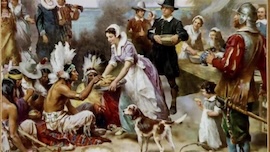
To celebrate their successful harvest, the Pilgrims planned a thanksgiving feast. This was not the first time people had given thanks, but it was the first big celebration in their new home. They invited Massasoit and about 90 Wampanoag men to join them.
The feast lasted three days. The Pilgrims prepared food from their harvest, like corn and vegetables. The Wampanoag brought deer and other meat. There were games, friendly competitions, and long conversations. They did not have pumpkin pie or mashed potatoes yet, but they enjoyed roasted birds, venison, and fresh corn.
The first Thanksgiving was not just a meal. It was a moment of cooperation between two very different groups of people. The Pilgrims were grateful for the help they received, and the Wampanoag were open to friendship at that time.
However, the peace did not last forever. In the years and generations after the first Thanksgiving, conflict and unfair treatment greatly harmed Native peoples. This darker history is also important, and many people today remember both the cooperation and the later suffering.
Still, the story of the first Thanksgiving shows how kindness and shared hope helped two communities through a difficult year. Today, many families in the United States celebrate Thanksgiving as a time to be grateful for food, home, and each other—just as the Pilgrims and Wampanoag did in 1621.
2. Pronunciation Practice — Word Families
Practice saying these words from the story. Each column has similar vowel or consonant sounds.
| Pilgrims | corn | peace | harvest | winter | Native |
|---|---|---|---|---|---|
| children | storm | feast | forest | river | nation |
| England | fork | leaf | farmers | settlers | later |
| Netherlands | north | teach | harbor | early | neighbor |
| religion | born | sea | planting | illness | famous |
| pilgrim | morning | seem | harvested | wintertime | people |
3. Vocabulary Matching A
Match the word to the correct meaning. Choose from the list.
4. Vocabulary Matching B
Match the word to the correct meaning.
5. Vocabulary in Context (Choose the Best Word)
Choose the best word from the list to complete each sentence. The choices are mixed.
-
The ________ left England because they wanted religious freedom.
-
The ship called the ________ carried 102 passengers across the ocean.
-
The ________ had lived in the area for thousands of years before the Pilgrims arrived.
-
________ taught the Pilgrims how to plant corn with fish in the soil.
-
The first winter in ________ was very hard, and many people died.
-
The Pilgrims and Wampanoag leaders made ________, and there was no war between them at that time.
-
The Pilgrims celebrated their first ________ after they grew enough food in 1621.
-
The first Thanksgiving was a time of ________ between the Pilgrims and the Wampanoag.
6. Multiple Choice Comprehension
1. Why did the Pilgrims first move to the Netherlands?
2. What was difficult about the Mayflower journey?
3. Where did the Pilgrims finally build their new home?
4. Why was the first winter so dangerous for the Pilgrims?
5. How did Squanto help the Pilgrims?
6. What did the Wampanoag bring to the first Thanksgiving feast?
7. How long did the first Thanksgiving feast last?
8. What important idea does the story of the first Thanksgiving show?
7. Cloze — Fill in the Blanks (Word Bank)
Instructions: Click a blank to select it, then click a word in the bank. Use the 🔎 button for a first-letter hint.
After they arrived in what is now (starts with "M") , they built a town called (starts with "P") . The first (starts with "w") was very hard, and many people died. In spring, a Native man named (starts with "S") visited the town and later brought (starts with "S") .
Squanto taught the Pilgrims how to plant (starts with "c") using fish as (starts with "f") . He helped them (starts with "s") and make (starts with "p") with the Wampanoag leader, (starts with "M") .
After a good (starts with "h") in 1621, they had a (starts with "f") with the (starts with "W") . Many (starts with "f") were (starts with "g") for the food and for the (starts with "c") between the two groups. Today, many people still celebrate (starts with "T") and think about what they are thankful for.
8. True or False
Mark each sentence T (True) or F (False).
9. Sequencing A & B — Put the Events in Order
Part A: Before Plymouth
Write the order (1–5) of these events before Plymouth.
```Part B: In Plymouth
Write the order (1–5) of these events after the Pilgrims arrive in North America.
10. For Example — Giving Reasons and Examples
Use for example, for instance, or such as to add details to each idea.
-
Many people are grateful on Thanksgiving.
Example: Many people are grateful on Thanksgiving, for example, for having a safe place to live. -
The Pilgrims needed help from the Wampanoag.
Write: The Pilgrims needed help from the Wampanoag, for example, … -
Squanto taught the Pilgrims important survival skills.
Write: Squanto taught important survival skills, such as … -
People celebrate Thanksgiving in many different ways.
Write: People celebrate Thanksgiving in many ways, for instance, …
11. Discussion and Writing Questions
Discuss these questions with a partner or choose one or two to write about in complete sentences.
- Why did the Pilgrims think it was worth the risk to move to North America?
- What are some ways the Wampanoag helped the Pilgrims? Why were these things important?
- What do you think was the most difficult part of the Pilgrims’ first year? Why?
- In your opinion, what is the most important message from the first Thanksgiving story?
- Do people celebrate a similar holiday in your country or culture? How is it the same or different from Thanksgiving?
- Today, some people also remember the pain and injustice that Native peoples suffered later. Why is it important to remember both the good and the bad parts of history?
12. Role-Play — Talking About Thanksgiving
Work with a partner. Read the dialogue, then change some details and practice again with your own ideas.
Juliana: Have you ever heard the true story of the first Thanksgiving?
Saeid: A little, but I only know about turkey and pumpkin pie.
Juliana: The story is about the Pilgrims and the Wampanoag in 1621 in Plymouth.
Saeid: Why did the Pilgrims come to North America?
Juliana: They wanted religious freedom and a new life, but the trip on the Mayflower was very hard.
Saeid: And the first winter was terrible, right?
Juliana: Yes, many people died. Later, Samoset and Squanto helped them survive.
Saeid: What did Squanto teach them?
Juliana: He showed them how to plant corn with fish, and how to find food in the area.
Saeid: So the first Thanksgiving was a celebration after a good harvest?
Juliana: Exactly. The Pilgrims and about ninety Wampanoag men shared a three-day feast.
Saeid: Today, many families eat together on Thanksgiving, but not everyone knows the full story.
Juliana: That’s true. We should also remember how Native peoples were treated later in history.
Saeid: I think Thanksgiving can be a time to be grateful and also to learn from the past.
Juliana: I agree. What are you thankful for this year?
Saeid: I’m thankful for my family and friends… and for good food, of course!
Juliana: Me too. Let’s write our own short Thanksgiving speech to share with the class.
Saeid: Great idea. For example, we can start with, “I am thankful for…”
13. Answer Key (Teacher Use)
3. Vocabulary Matching A
1. Pilgrims → a group of English people who left their country for religious freedom
2. Mayflower → the wooden ship that carried the Pilgrims to North America
3. Wampanoag → a Native American people living near Plymouth
4. harvest → the time when farmers bring in their crops
5. feast → a very large and special meal

4. Vocabulary Matching B

5. survive → to stay alive during a difficult time

6. fertilizer → material added to soil to help plants grow

7. venison → meat from a deer

8. cooperation → people working together for the same goal

9. peace → a time without war or fighting

10. Vocabulary in Context

11. Pilgrims

12. Mayflower

13. Wampanoag

14. Squanto

15. Plymouth

16. peace

17. harvest

18. cooperation

19. Multiple Choice

20. They wanted to practice their religion freely.

21. There were strong autumn storms and many people were sick.

22. In Plymouth, in present-day Massachusetts.

23. Their houses were not ready and there was not enough food.

24. He taught them how to grow food and find local resources.

25. They brought deer and other meat.

26. About three days.

27. That cooperation and kindness helped two groups in a hard time.

28. Cloze — Fill in the Blanks
    Pilgrims, England, Netherlands, Mayflower, Ocean, storms,
    Massachusetts, Plymouth, winter, Samoset, Squanto,
    corn, fertilizer, survive, peace, Massasoit,
    harvest, feast, Wampanoag, families, grateful,
    cooperation, Thanksgiving

29. True or False

30. T

31. F

32. T

33. F

34. T

35. T

36. F

37. T

38. Sequencing A (Before Plymouth)
    1 → The Pilgrims feel unsafe in England because of their religion.
    2 → They move to the Netherlands and live there for several years.
    3 → They worry that their children are forgetting English.
    4 → They decide to sail to North America.
    5 → They find the Mayflower and prepare for the trip.

39. Sequencing B (In Plymouth)
    1 → The Mayflower reaches the coast and the Pilgrims choose a place for Plymouth.
    2 → The first winter is very hard, and many Pilgrims die.
    3 → Samoset visits Plymouth and later brings Squanto.
    4 → Squanto helps the Pilgrims grow food and make peace with Massasoit.
    5 → The Pilgrims and Wampanoag celebrate the first Thanksgiving feast.