A Lizard In A Blizzard Interactive Worksheet

Link List MiClase.org
Read the Story

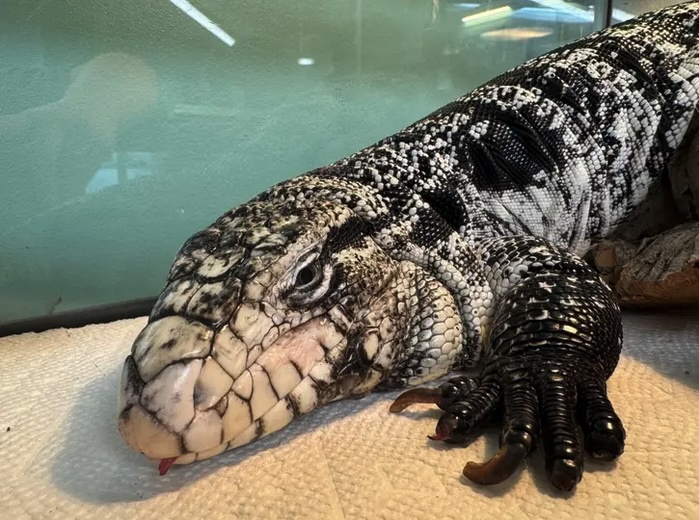
PROVIDENCE, RI — A Providence man shoveling his driveway discovered a huge, frozen South American lizard clinging to life beneath 20 inches of snow, according to the New England Wildlife Center.

"Thankfully it takes more than a couple feet of snow and a rogue reptile to rattle this resident," the center said in a Facebook post.

"He kindly brought the lizard inside right away and wrapped him in a t-shirt to help conserve heat," the post said. "He then reached out to Taylor and Emily, co-owners of ET Reptiles, who responded immediately and went to retrieve the animal to give him the best possible chance of survival."

The tegu gradually up to room temperature while a trip to the New England Wildlife Center hospital was arranged, according to the post.

At the hospital, the lizard was found to be "extremely weak, underweight, and not moving well," the post said. "He had suffered frostbite to his tongue and showed signs of significant muscle weakness after prolonged exposure to the cold."

A small portion of nonviable tissue was amputated from the lizard's tongue and he was "provided supportive care, including steroids, to help address inflammation and generalized weakness," according to the post, that said the lizard was "resting comfortably and finally warm."

Tegus are native to South America but have become an invasive species in the state of Florida, according to the Jacksonville Zoo.

"These robust reptiles, known for their intelligence and adaptability, were first introduced to the state through the pet trade," according to a post on the zoo's Facebook page. "However, their ability to establish thriving populations — hundreds of them are trapped and removed from the wild every year — has raised serious ecological concerns."

Tegus mature rapidly and can grow to more than 4-feet long and weigh 20 pounds, per the zoo's page.

Vocabulary — Matching (A & B)
Click a word, then click its definition. Correct pairs lock.
A • Matched: 0/0 A • Correct: 0/0
B • Matched: 0/0 B • Correct: 0/0
Vocabulary in Context
Answered: 0/0 Correct: 0/0
Comprehension — Multiple Choice
All answers start as a dash (—). Choices are shuffled on load.
Answered: 0/0 Correct: 0/0
Cloze (17 blanks) — with hint peeks
Filled: 0/0 Correct: 0/0
Word Bank (shuffled):
True / False
Answered: 0/0 Correct: 0/0
Sequencing (A & B) — drag to reorder
Drag items to put them in order. On phones/tablets, press and drag.
A • In place: 0/0
    B • In place: 0/0
      “For Example”
      Discussion / Writing
      Role Play — Dialogue (18 lines)

      Mark: I was shoveling my driveway, and I saw something strange in the snow.

      Emily: What did you see?

      Mark: A big lizard—barely moving—under a lot of snow.

      Taylor: Under snow? In this weather? That’s dangerous for a reptile.

      Mark: I brought it inside right away and wrapped it in a T-shirt to conserve heat.

      Emily: That was smart. Warming it slowly is important.

      Mark: I didn’t know who to call, so I reached out to ET Reptiles.

      Taylor: We came immediately to retrieve the animal and get it help.

      Emily: While the wildlife hospital trip was arranged, it warmed up gradually to room temperature.

      Mark: At the hospital, was it okay?

      Dr. Rivera: It was extremely weak, underweight, and not moving well.

      Dr. Rivera: It had frostbite on its tongue and showed muscle weakness after prolonged exposure.

      Mark: What did you do for it?

      Dr. Rivera: We amputated a small portion of nonviable tissue from the tongue.

      Dr. Rivera: Then we provided supportive care, including steroids, to reduce inflammation and help strength.

      Emily: The good news is it’s resting comfortably and finally warm.

      Taylor: Tegus are native to South America, but in Florida they’ve become an invasive species.

      Mark: I’m just glad this one got a second chance.

      Answer Key