Yellowstone: A Living Land of Fire and Wonder
A reading lesson on nature, history, and conservation
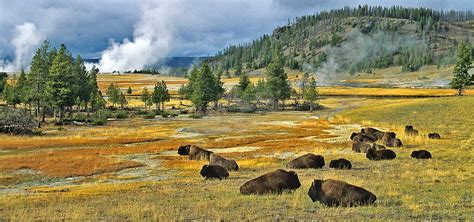
yellowstone1.jpg to the images1 folder beside odds.and.ends.index.html.A Landscape That Breathes
At dawn, Yellowstone seems to breathe. Steam rises into the cold mountain air, a river slips through a meadow, and the dark shapes of bison move across the grass. Somewhere beyond the trees, a geyser sends a fountain of hot water toward the sky. This is a place where the forces beneath Earth’s surface meet the everyday lives of animals, plants, and people. Beautiful as it is, Yellowstone is more than scenery: it is a landscape still being made.
Spreading across roughly 2.2 million acres, Yellowstone National Park lies mostly in Wyoming, with smaller portions in Montana and Idaho. Forests, grasslands, lakes, and mountains form a vast patchwork of habitats. A traveler might watch steam drifting over a hot spring in the morning and hear the thunder of a waterfall by afternoon. The park’s remarkable character comes from that meeting of fire, water, wildlife, and deep human history.
Homeland Before It Was a Park
Yellowstone’s human story began more than 11,000 years ago, long before anyone drew a national park boundary. Indigenous peoples traveled through and lived in the region, hunting animals, gathering plants, and maintaining relationships with places of cultural and spiritual importance. Obsidian, a volcanic glass that can be chipped into sharp edges, was a valuable material for tools and trade.
The land was never an empty wilderness waiting to be discovered. Its history includes the ancestors of several present-day Tribal nations, whose connections to Yellowstone continue. Establishing the park did not erase those relationships, although government policies and exclusion restricted Indigenous access. Understanding Yellowstone means holding both stories together: the protection of an extraordinary landscape and the experiences of people whose homeland it already was.
An Idea That Changed Conservation
During the nineteenth century, accounts of Yellowstone’s steaming ground and erupting fountains captured the attention of people far beyond the region. The 1871 expedition led by geologist Ferdinand V. Hayden helped document its wonders. Photographs by William Henry Jackson and paintings by Thomas Moran made distant landscapes vivid to audiences who had never seen them.
On March 1, 1872, President Ulysses S. Grant signed the law establishing Yellowstone as the world’s first national park. The decision reserved a remarkable landscape for public benefit instead of allowing it to be divided into private developments. Protection, however, required more than a signature. Poaching and damage remained problems. The U.S. Army began administering the park in 1886, and the National Park Service took over in 1918. Yellowstone helped establish an idea that would spread internationally: some places deserve lasting public protection.
Fire Beneath the Forest
Yellowstone’s volcanic story is written on an enormous scale. About 631,000 years ago, a massive eruption created the Yellowstone Caldera, a broad depression formed as the ground collapsed into space left by erupted magma. Instead of a single dramatic cone, much of this volcanic landscape stretches across a wide plateau.
Heat from the volcanic system still warms groundwater. In a geyser, underground passages restrict the movement of water, allowing pressure and heat to build until an eruption occurs. A hot spring allows water to circulate more freely. Yellowstone contains more than 10,000 hydrothermal features, including more than 500 geysers, as well as bubbling mudpots and steam vents called fumaroles. Old Faithful is the best-known geyser, famous for eruptions that can often be predicted within a time window. Its name does not mean it erupts at an exact hourly interval.
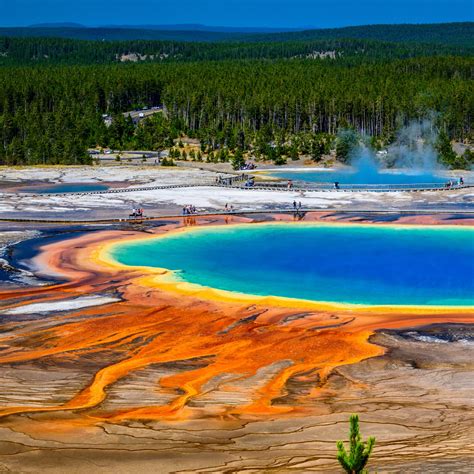
yellowstone2.jpg to the images1 folder beside odds.and.ends.index.html.A World of Color and Moving Water
At Grand Prismatic Spring, blue water is bordered by bands of brilliant color. Heat-loving microorganisms called thermophiles help create the colorful margins of Yellowstone’s hot springs. Different communities flourish under different temperatures and chemical conditions. What looks like an artist’s palette is also a living habitat, revealing that life can thrive in environments that would be dangerous to humans.
Water shapes quieter wonders, too. Yellowstone Lake spreads beneath the mountain sky, while the Yellowstone River carves through the Grand Canyon of the Yellowstone. Waterfalls plunge between walls streaked with yellow, orange, and red. At Mammoth Hot Springs, mineral-rich water builds terraces of travertine, a form of limestone. These terraces show that water can build landscapes as well as wear them away.
Where Wild Lives Intersect
In Yellowstone, a bison crossing a meadow is part of a much older story. The park is the only place in the lower 48 states where a free-ranging bison population has persisted continuously since prehistoric times. Elk, bears, wolves, and many other animals share the landscape, making Yellowstone a place to observe relationships between predators, prey, scavengers, and the plants that support them.
Wolves were eliminated from the park by the early twentieth century. Their reintroduction began in 1995, restoring a missing predator. Wolves affect elk and provide food for scavengers through the carcasses they leave behind. Their return also helps scientists study how species influence one another. Changes in vegetation and rivers, however, cannot be explained by wolves alone: weather, water, other animals, and many interacting factors matter. Yellowstone’s web of life is wonderfully complex.
A Place That Changes—and Endures
The fires of 1988 made Yellowstone’s changing nature impossible to ignore. Images of burning forests alarmed people around the world, yet the years afterward revealed new growth among the blackened trunks. Some lodgepole pines carry cones sealed with resin that heat can open, releasing seeds. Fire can create sunny spaces for seedlings and renew habitats, even as it threatens buildings and transforms familiar views.
Yellowstone’s future depends on understanding such change while caring for what makes the park special. Its value lies in more than famous landmarks. It is a place where Indigenous history remains connected to the present, where tiny organisms paint hot springs, and where great herds still move across open country. To learn about Yellowstone is to see conservation as an ongoing responsibility: protecting a living landscape while allowing its natural stories to continue.
Test Your Knowledge
Choose one answer for each question, then select Submit Answers. Unanswered questions count as zero. You can revise your choices and submit again.